💡 Introduction
Selecting the right crane for a lift requires precise calculations to ensure safety and efficiency. This guide will walk you through the essential steps, including load calculations, sling selection, crane SWL verification, and ground bearing pressure assessment.
✅ 1. Calculate Net Load + 20% Safety Margin
The actual load weight must be increased by 20% to account for external factors like wind, load swinging, and dynamic forces.
✅ Formula:
Net Load × 1.2 = Total Load (with Safety Margin)
🧮 Example:
3.8t × 1.2 = 4.56t
Thus, the load to consider is 4.56 tons.
⚖️ 2. Determine the Minimum SWL of the Sling
The Safe Working Load (SWL) of the sling depends on the lifting method used. Use the Mode Factor to calculate the required SWL.
Mode Factors Table
| Sling Method | Mode Factor |
|---|---|
| Vertical | 1.0 |
| Choke | 0.8 |
| Basket (U) | 2.0 |
| 2-Leg 90° | 1.4 |
| 2-Leg 60° | 1.7 |
| 2-Leg 45° | 2.1 |
✅ Formula:
Total Load ÷ Mode Factor = Minimum Sling SWL
🧮 Example:
4.56t ÷ 2.1 = 2.17t
Thus, each sling must have an SWL of at least 2.17 tons.
📏 3. Calculate Minimum Sling Length
To ensure stability, calculate the required sling length using the Pythagorean theorem.
✅ Formula:
√(L² + W²) = Sling Length
🧮 Example:
√(4² + 3²) = √(16 + 9) = √25 = 5m
Thus, the minimum sling length required is 5 meters.
🛠 4. List of Accessories & Their Weight
Lifting accessories add extra weight to the load.
| Accessory | Approx Weight |
| Bow Shackle 25mm | 3.5 kg |
| Sling Hook | 5 kg |
| Chain Block | 20 kg |
| Spreader Beam | 150 kg |
| D-Shackle | 4 kg |
⚖️ 5. Convert Load to Kilograms
✅ Formula:
1 ton = 1000 kg
🧮 Example:
4.56t × 1000 = 4560kg
➕ 6. Find Gross Load (Load + Accessories Weight)
✅ Formula:
Load Weight + Accessories Weight = Gross Load
🧮 Example:
4560kg + 240kg = 4800kg
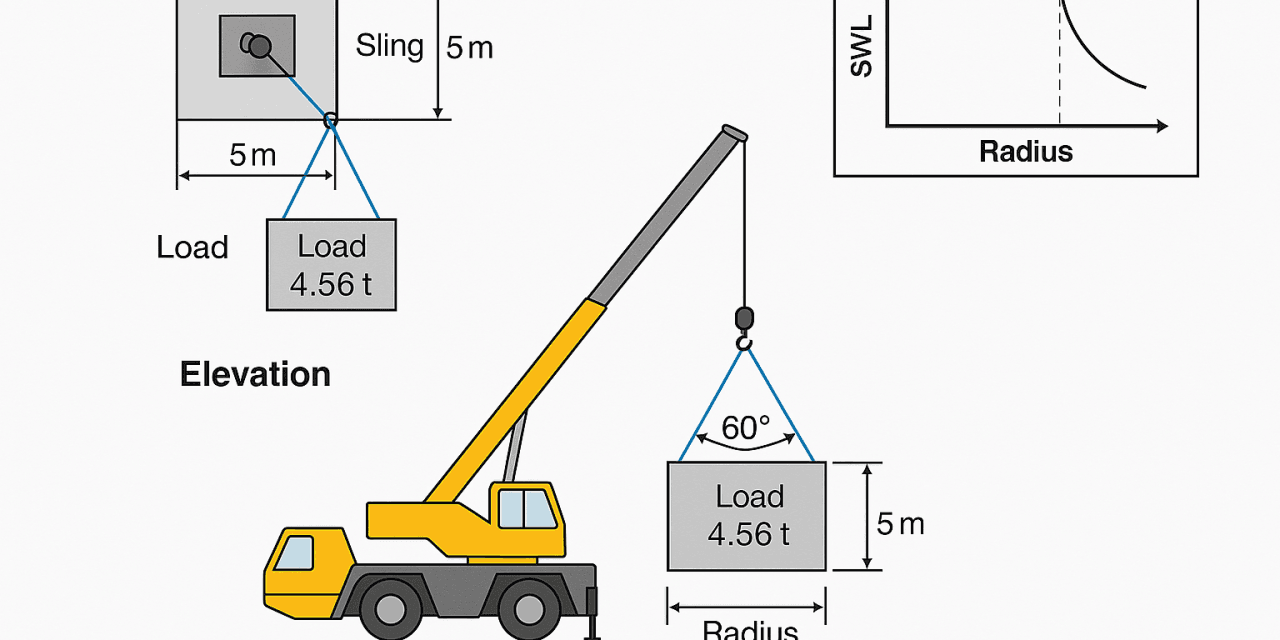
📐 7. Plan & Elevation Drawing
To ensure safe lifting, create a plan and elevation drawing, including:
✅ Load positioning
✅ Sling angles
✅ Boom length & radius
✅ Crane location & obstructions
(A diagram will be added below.)
🚛 8. Choose the Right Crane (Boom Length & Radius)
Select a crane that can safely lift the Gross Load within the required radius. Refer to the crane manufacturer’s load charts.
⚠️ 9. Apply Safety Factor to SWL of the Crane
✅ Formula:
SWL of Crane × 0.9 ≥ Gross Load
🧮 Example:
6.5t × 0.9 = 5.85t
Thus, the crane must have an SWL of at least 5.85t.
📝 10. Key Notes for Drawing
✅ Boom Length
✅ Crane SWL
✅ Counterweight
✅ Axle Weight
✅ Ground Condition
📊 11. Utilization Rate Calculation
✅ Formula:
(Gross Load × 100) ÷ Crane SWL = Utilization Rate
🧮 Example:
(4.8t × 100) ÷ 6.5t = 73.84% ✅
(Must be below 90% for safe operation.)
🧱 12. Ground Bearing Pressure (GBP) & Mat Selection
✅ Formula:
(0.75 × Crane Weight) + Gross Load ÷ GBP = Minimum Mat Area
🧮 Example:
(41t × 0.75) + 4.8t = 30.75 + 4.8 = 35.6t
35.6t ÷ 25t/m² = 1.42 m²
Thus, choose a mat ≥ 1.42 m².
✅ Final Check Summary
| Check | Requirement | Example Value |
| Gross Load | Load + Accessories | 4800 kg |
| Sling SWL | Load ÷ Mode Factor | ≥ 2.17t |
| Sling Length | √(L² + W²) | 5m |
| Crane SWL Margin | 10% Reserve | 5.85t ≥ 4.8t |
| Utilization Rate | <90% | 73.84% ✅ |
| GBP | ≤ 25 t/m² | 24.65 t/m² ✅ |
💬 Need a Diagram?
Would you like a plan & elevation sketch or a sling configuration diagram for this setup? Let me know, and I’ll generate one!
📢 About EngineerHow.com
🚀 EngineerHow.com provides detailed guides on engineering, IT, and self-hosting solutions. Subscribe to our YouTube channel for video tutorials!
💬 Have questions? Drop a comment below! 👇