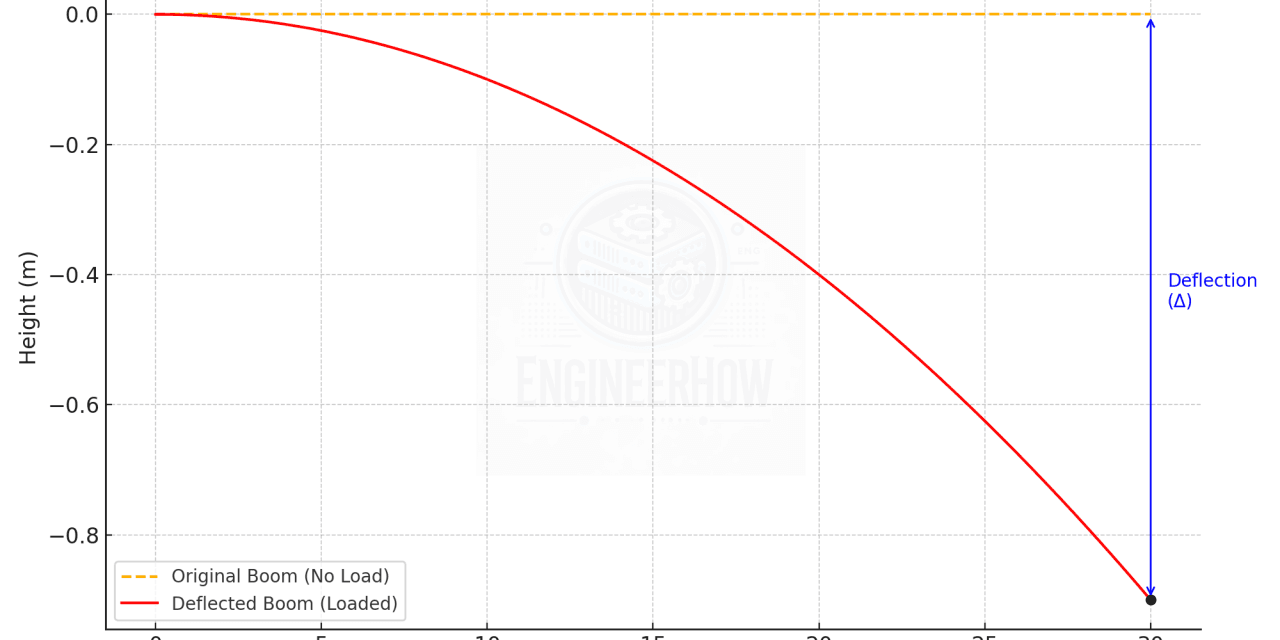
📌 What is Boom Deflection?
Boom deflection refers to the vertical displacement (bending) of a crane boom when it lifts a load. This is a normal and expected behavior due to the elastic properties of the boom, but it must be accounted for during lifts to ensure accuracy and safety.
📐 Why Boom Deflection Matters:
- Ensures accurate load placement
- Prevents uncontrolled load swing
- Accounts for structural limitations
✅ Boom Deflection Formula (Theoretical):

Deflection (Δ) = W.L^3/3.E.I
- Δ = Boom tip deflection (m)
- W = Load (N)
- L = Boom length (m)
- E = Modulus of elasticity (N/m²)
- I = Moment of inertia (m⁴)
🔍 Simplified Field Estimation:
For mobile cranes, manufacturers provide estimates like:
Deflection ≈ 2 to 5 mm × boom length (m) × load (ton)
📊 Example 1: Field Estimate
- Crane: Zoomlion QY-30V
- Load: 10 tons
- Boom: 30 meters
- Deflection:
3 mm × 30 × 10 = 900 mm = 0.9 m
📊 Example 2: Using Manufacturer Factor
- Deflection Factor: 2.5 mm/ton/m
- Load: 12 tons
- Boom: 25 meters
- Deflection:
2.5 × 25 × 12 = 750 mm = 0.75 m
🖼️ Boom Deflection Diagram
⚠️ Appointed Person Checklist
| Item | Checked? |
|---|---|
| Boom length vs. max rated | ✅ |
| Expected deflection calculated | ✅ |
| Load path clear of obstacles | ✅ |
| Riggers informed of deflection | ✅ |
| Tag lines used to control load | ✅ |
🧰 Tools & Resources
- 📊 Boom Deflection Excel Template
- Crane manufacturer manuals
- Structural calculators and lifting plan tools
📢 Recommendation
To learn more about lifting operations, visit EngineerHow.com and subscribe to our YouTube Channel for tutorials, diagrams, and training guides.
© 2025 EngineerHow.com | All rights reserved.