

Introduction
In lifting operations involving mobile cranes, ensuring proper weight distribution on each outrigger is critical for crane stability and ground safety. Miscalculations can lead to crane tipping, structural failure, or ground collapse. This guide explains how to calculate the load on each outrigger, supported by diagrams, an Excel template, and software recommendations.
📈 Total Load Consideration
To begin, calculate the total weight supported by the crane:
✅ Step-by-Step Guide to Calculate Load Distribution on Outriggers
🔧 Assumptions for Calculation:
- Crane is fully rigged on 4 outriggers
- Load is static and centered at a given radius
- Ground is level (unless otherwise noted)
- Crane weight and load weight are known
- Center of gravity (CG) is known or assumed
🧮 Example Calculation
Crane Type: Zoomlion QY-30V
Crane Weight (CW): 24,000 kg
Load Weight (LW): 6,000 kg
Outrigger Configuration: 4 outriggers – Front Left (FL), Front Right (FR), Rear Left (RL), Rear Right (RR)
Boom Facing: Forward (Over Front)
CG Location: Near center, 1.5 m behind front outriggers
📐 1. Calculate Total Weight
Total Weight = Crane Weight + Load Weight
             = 24,000 + 6,000
             = 30,000 kg
🧭 2. Determine CG Location (From Front)
Assume CG is 3.5 m from the front of the crane and the distance between front and rear outriggers is 5 m.
Distance from front to CG = 3.5 m
Outrigger Span = 5 m
Use the principle of moments to find how the weight distributes between front and rear outriggers.
⚖️ 3. Front vs Rear Load Distribution
Let:
- F = total load on front outriggers
- R = total load on rear outriggers
By moment balance (about CG):
F * 0 = R * 5
R = (3.5 / 5) * 30,000 = 21,000 kg
F = 30,000 - 21,000 = 9,000 kg
So:
- Front Outriggers share = 9,000 kg
- Rear Outriggers share = 21,000 kg
🔄 4. Divide Between Left & Right (Assuming Load is Centered)
Assume the crane is symmetric left to right:
Each front outrigger:
9,000 / 2 = 4,500 kgEach rear outrigger:
21,000 / 2 = 10,500 kg
✅ Final Result (Per Outrigger):
| Outrigger | Load (kg) |
|---|---|
| Front Left (FL) | 4,500 |
| Front Right (FR) | 4,500 |
| Rear Left (RL) | 10,500 |
| Rear Right (RR) | 10,500 |
🔢 Step-by-Step Calculation Simple Example
Scenario:
Crane Model: Zoomlion QY-30V
Crane Weight (CW): 24,000 kg
Load Weight (LW): 6,000 kg
Boom Facing: Forward
Outrigger Configuration: 4 (FL, FR, RL, RR)
CG (Center of Gravity): 3.5 m from front, total span between front and rear outriggers = 5 m
1. Total Weight
2. Moment Balance Around CG
To find load on front (F) and rear (R) outriggers:
3. Left-Right Symmetry (Assumed)
Front Left (FL) = 9,000 / 2 = 4,500 kg
Front Right (FR) = 4,500 kg
Rear Left (RL) = 21,000 / 2 = 10,500 kg
Rear Right (RR) = 10,500 kg
📊 Final Outrigger Load Table
| Outrigger | Load (kg) | Notes |
|---|---|---|
| Front Left (FL) | 4,500 | Assumed symmetric |
| Front Right (FR) | 4,500 | Assumed symmetric |
| Rear Left (RL) | 10,500 | Heavier due to CG |
| Rear Right (RR) | 10,500 | Heavier due to CG |
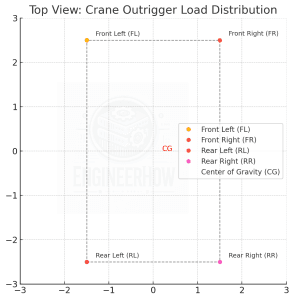
🎨 Top View Diagram
A top-view diagram is shown below to visualize outrigger positioning and weight distribution. The crane body is centered, and the CG is marked in red.
📊 Excel Template
To make your job easier, download and modify the Excel sheet:
You can change the total weight, CG distance, or outrigger span, and it will calculate load distribution automatically.
🛠️ Useful Software Tools
| Software | Purpose | Link |
| Draw.io | Drawing lifting plans | https://draw.io |
| Crane Lift Planner | OEM-specific load simulations | OEM Sites (e.g., Liebherr, Tadano) |
| AutoCAD | Technical diagram drafting | Paid |
| Excel | Manual calculation + automation | Built-in |
⚠️ Important Notes
Adjust calculations if boom is over corner or side.
Manufacturer load charts override field calculations.
Always account for ground bearing pressure and use mats/pads if required.
✉️ Recommend: Visit EngineerHow.com regularly for more lifting safety tips. Subscribe to our YouTube Channel for visual guides.
© 2025 EngineerHow.com | All rights reserved


