🧲 Understanding Mass: Definition, Examples & Why It’s Not the Same as Weight
🔍 What is Mass?
Mass is the amount of matter that makes up an object. It is a fixed quantity that does not change, no matter where the object is in the universe.
📌 Definition:
Mass is a measure of how much matter an object contains.
It is measured in kilograms (kg) or grams (g) and is determined using a balance scale.
🚫 Why Mass is NOT the Same as Weight
Many people mistakenly believe that mass and weight are the same thing. But here’s the truth:
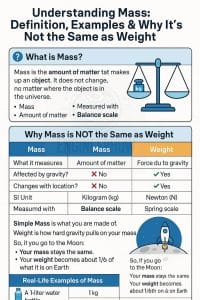
| Property | Mass | Weight |
|---|---|---|
| What it measures | Amount of matter | Force due to gravity |
| Affected by gravity? | ❌ No | ✅ Yes |
| Changes with location? | ❌ No | ✅ Yes |
| SI Unit | Kilogram (kg) | Newton (N) |
| Measured with | Balance scale | Spring scale |
🧠 Simple Way to Remember
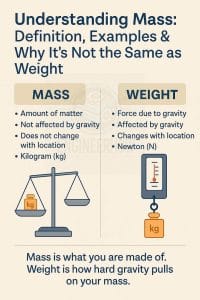
Mass is what you are made of.
Weight is how hard gravity pulls on your mass.
So, if you go to the Moon:
- Your mass stays the same.
- Your weight becomes about 1/6th of what it is on Earth because the Moon’s gravity is weaker.
📘 Real-Life Examples of Mass
| Object | Mass (Approximate) |
|---|---|
| A 1-liter water bottle | 1 kg |
| A school backpack | 5–10 kg |
| A car battery | ~20 kg |
| A mobile crane (Zoomlion) | ~25,000+ kg |
🏗️ Why Mass Matters in Lifting & Crane Operations
In lifting operations, especially when using cranes, knowing the mass of the load is critical for safe and efficient work. Misunderstanding mass vs. weight can lead to serious safety risks, equipment damage, or even fatal accidents.
⚠️ Key Reasons Mass is Crucial in Lifting:
1. Accurate Load Calculations
Every crane has a load chart that specifies the maximum safe working load (SWL) at different boom lengths and angles.
These charts are based on the mass of the load, not just estimated weight.
Overestimating or underestimating mass can result in overload or tipping.
2. Rigging & Sling Selection
Before lifting, rigging equipment such as slings, shackles, or chains must be chosen based on the mass of the object.
If the mass is unknown or guessed, the rigging might fail under tension.
3. Ground Bearing Pressure
The mass of the crane + the load determines the pressure exerted on the ground.
If the ground cannot support the combined mass, it may lead to crane instability or collapse.
Proper load distribution mats or steel plates are selected using these mass values.
4. Dynamic Effects in Lifting
When a load is in motion (especially during sudden starts/stops), its effective force increases due to inertia.
This depends directly on mass and acceleration:
Force = Mass × Acceleration (F = m × a)
🧠 Practical Example
Suppose you’re lifting a concrete block with a known mass of 2,000 kg using a Zoomlion QY-30V mobile crane:
At an 8 m radius, the crane’s SWL is ~16,000 kg.
You must account for:
Load mass (2,000 kg)
Rigging gear mass (e.g., 200 kg)
Dynamic factors
Boom length and angle
Even a small underestimation of mass could push the crane beyond safe limits, violating the lifting plan.
✅ Checklist for Crane Operators & Appointed Persons:
Confirm the mass of the load using drawings, manufacturer info, or scales
Include rigging gear mass in calculations
Use load charts specific to crane make/model
Ensure ground conditions support total combined mass
Document in the Lift Plan and verify before lifting
📣 Conclusion
Understanding the difference between mass and weight is essential in both science and lifting operations.
Avoid the common mistake of using the terms interchangeably—they are not the same.
For more foundational science and safe lifting tips, check out EngineerHow.com and follow us on YouTube.
© 2025 EngineerHow.com | All rights reserved