❓ Question
Ideally, when setting up a mobile crane for level, within what percentage inclination does the crane have to be for the gross ratings of the load chart to remain valid?
- A. It doesn’t matter as long as the stabilizer legs are fully deployed
- B. 1% inclination ✅
- C. 2% inclination
- D. 10% inclination
✅ Correct Answer: B. 1% inclination
📖 Detailed Explanation
What is Inclination?
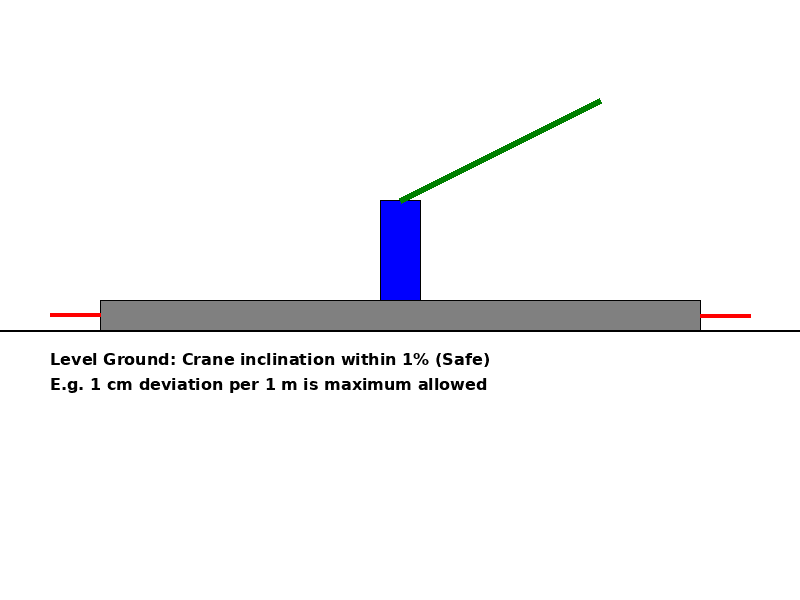
Inclination refers to the tilt or slope of the crane from a perfectly horizontal level. For lifting operations, maintaining the crane within 1% of level is critical to ensure the crane performs according to its load chart.
- 1% inclination means a 1 cm vertical deviation over a 1-meter horizontal distance
- If exceeded, the crane may become unstable, and the manufacturer’s load ratings become invalid
🔧 Why 1% is Critical
Load Radius Changes
Even a small tilt increases the horizontal distance (radius) from the center of rotation to the load. This effectively increases the load moment, potentially exceeding the crane’s capacity.Boom Angle Affected
Tilting changes the boom’s working angle, which directly affects lifting capability.Crane Stability is Reduced
The crane’s center of gravity shifts, increasing the chance of tip-over, especially under heavy loads or high boom extensions.
🧠 Real-World Example
Example:
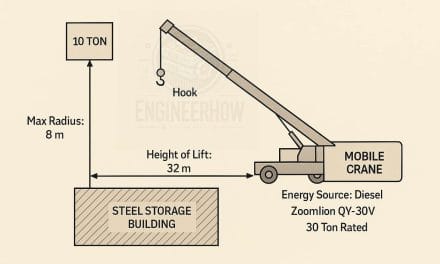
A mobile crane is set up on uneven ground. The operator deploys all outriggers fully but forgets to check the level. The inclinometer shows a 2.5% tilt.
- The boom is set to lift 10 tons at 8m radius.
- Due to the tilt, the actual radius increases to 8.6m, and the effective load increases beyond rated capacity.
- The crane becomes unstable, and the lift is at risk of failure or tipping.
Had the crane been leveled within 1%, the load chart rating would have remained valid and safe.
📷 Visual Guide
Safe Crane Setup Example

A crane leveled on a flat surface using outriggers and a digital inclinometer. Staying within 1% of level ensures safety and accuracy.
❌ Why Other Options Are Incorrect
| Option | Explanation |
|---|---|
| A | Outriggers help stabilize, but without proper leveling, tilt can still cause instability |
| C | 2% is above manufacturer’s tolerance and leads to incorrect boom angles |
| D | 10% is extremely unsafe and highly likely to cause tip-over |
🛠️ Best Practices for Crane Leveling
| Action | Why It’s Important |
|---|---|
| Use a digital inclinometer | For accurate, real-time tilt measurement |
| Level front-to-back and side-to-side | Ensures proper load balancing |
| Deploy outriggers evenly with pads | Avoids sinkage and uneven pressure |
| Re-check after each lift setup | Ground may shift, requiring adjustments |
🔎 Summary Table
| Requirement | Detail |
|---|---|
| Max Allowed Inclination | 1% |
| Tools Needed | Inclinometer, crane computer system |
| Mistake to Avoid | Relying only on visual level or outriggers |
| Effect of Violation | Invalid load chart, tip-over risk, equipment damage |
📘 Related Topics on EngineerHow
- How to Read a Crane Load Chart
- Outrigger Pad Size Calculation
- Digital Tools for Crane Operators
- Crane Lift Plan Example with Diagrams
Visit our site: EngineerHow.com
📺 Watch training videos at: YouTube Channel
© 2025 EngineerHow.com | All rights reserved