
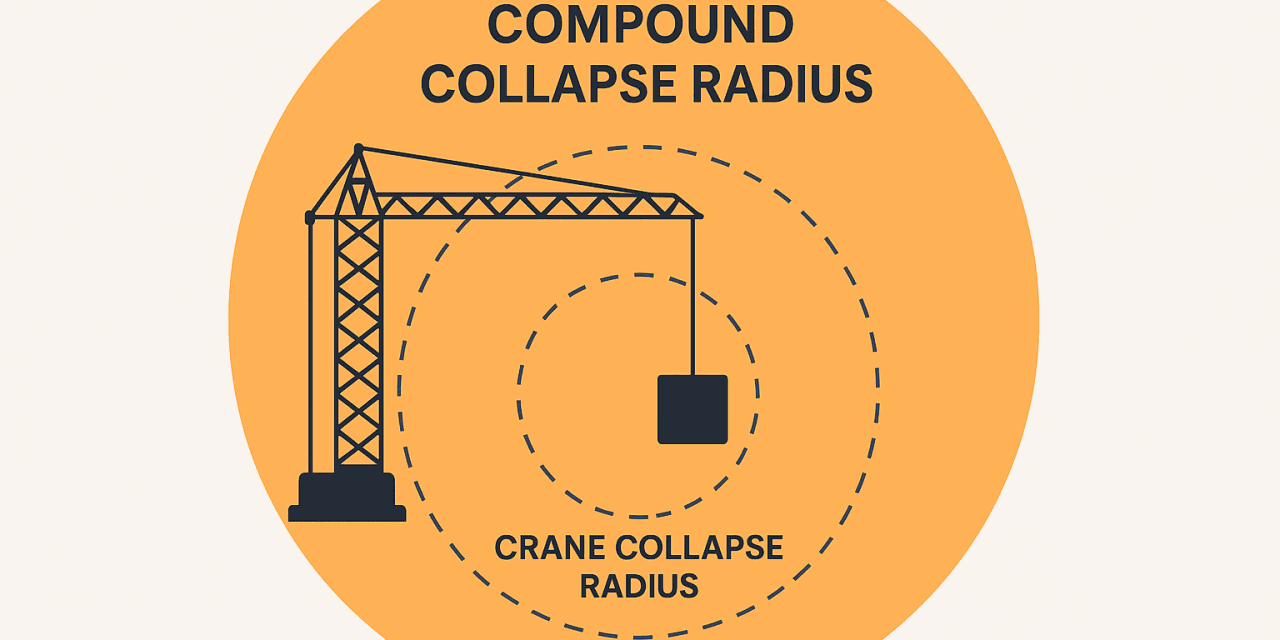
🏗️ What Is Compound Collapse Radius in Crane Operations?
In construction and lifting operations, understanding safety zones is critical to protect both workers and equipment. One important term you might encounter during crane-related safety training is the Compound Collapse Radius. But what does it really mean?
Let’s break it down. 👇
🔍 Definition
The Compound Collapse Radius refers to the total potential fall zone around a crane, accounting for both:
The crane itself, in case it collapses or tips over.
The load being lifted, which could swing or fall during lifting failure.
📌 In simple terms:
Compound Collapse Radius = Crane Collapse Radius + Load Collapse Radius
This combined zone is crucial when planning a construction site or lifting operation, as it defines the total area that must be kept clear of personnel, vehicles, and sensitive equipment for maximum safety.
🧠 Use Case Example
Imagine you are lifting a heavy beam using a tower crane on a job site.
The crane has a collapse radius of 15 meters.
The load could potentially swing or fall another 10 meters beyond that.
✅ You must account for 25 meters around the crane as a no-go zone — that’s the compound collapse radius.
This zone should be clearly marked, barricaded, and monitored to prevent unauthorized access during crane operations.
📊 Comparison Table
| Term | Meaning | Risk Zone Example |
|---|---|---|
| Crane Collapse Radius | Area the crane may fall if it collapses | 15m |
| Load Collapse Radius | Area where the load might fall or swing | 10m |
| Compound Collapse Radius | Combined risk area of crane + load | 25m |
🧯 Why Is It Important?
🚧 Prevents fatal accidents and injuries
📐 Helps safety officers plan evacuation zones
🚫 Avoids property damage on-site
📋 Often part of compliance with HSE/OSHA standards
📷 Visual Example
Here’s a basic diagram to help you visualize it better:
(Replace with your actual uploaded image URL)
✅ Conclusion
Understanding and applying the compound collapse radius is essential for anyone involved in crane operations. It’s not just a theoretical concept — it’s a life-saving safety buffer.
So next time you’re on a job site with a crane in operation, make sure you’re well outside that compound collapse radius.
💬 What do you think?
Have you seen unsafe practices around cranes before? Share your experiences or ask questions in the comments below!
🔁 Share this post with your team or anyone working in lifting and rigging!


