

Introduction
Lifting operations are critical in construction, engineering, and industrial environments. To ensure safety and efficiency, a Lifting Appointed Person (AP) is responsible for planning and overseeing these operations. This guide covers key concepts, from lifting plans and load calculations to crane selection and accessories, with real-world workplace examples and detailed illustrations.
1. Who is a Lifting Appointed Person (AP)?
An Appointed Person (AP) is responsible for planning, controlling, and overseeing lifting operations. According to BS 7121 (Safe Use of Cranes) and ISO 12480, their duties include:
Conducting risk assessments and lifting plans.
Selecting the right crane and lifting accessories.
Ensuring compliance with safety regulations (LOLER, PUWER).
Supervising lifting operations and instructing the team.
Preventing workplace accidents by ensuring safe lifting practices.
Workplace Example:
A logistics company in Oman required lifting heavy transformers using a mobile crane. The Appointed Person conducted a site survey, identified underground pipelines, and adjusted the crane positioning to prevent ground failure. This prevented a potential collapse and ensured smooth lifting operations.
2. What is a Lifting Plan? Key Components
A Lifting Plan is essential for safe lifting operations. It includes:
✅ Risk Assessment – Identifying hazards & control measures.
✅ Method Statement – Step-by-step operation guidelines.
✅ Crane Selection & Positioning – Load capacity & stability.
✅ Lifting Accessories – Slings, shackles, and hooks.
Lifting Plan Components with Example
A lifting plan is essential for ensuring safe and efficient lifting operations. Here are the key components of a lifting plan, along with an example:
Key Components of a Lifting Plan
General Information:
- Project Details: Name, location, and description of the project.
- Date and Time: When the lift will take place.
- Personnel: Names and roles of the personnel involved (e.g., crane operator, rigger, signal person).
Lift Description:
- Load Details: Description of the load, including weight, dimensions, and center of gravity.
- Lift Type: Type of lift (e.g., critical, standard).
Equipment Details:
- Crane Information: Type, capacity, and configuration of the crane.
- Rigging Equipment: Details of slings, shackles, and other rigging gear.
Site Conditions:
- Ground Conditions: Stability and suitability of the ground for crane operations.
- Environmental Factors: Weather conditions, wind speed, and visibility.
Safety Measures:
- Hazard Identification: Potential hazards and mitigation measures.
- Emergency Procedures: Steps to take in case of an emergency.
Lift Plan Diagram:
- Site Layout: Diagram showing the lift area, crane position, and load path.
- Load Path: Clear path for the load from pick-up to set-down points.
Approval and Signatures:
- Approval: Signatures from the project manager, crane operator, and safety officer.
Example of a Lifting Plan
Here’s a simplified example of a lifting plan for a critical lift:
Project Details
- Project Name: High-Rise Construction
- Location: Downtown City Center
- Date and Time: March 15, 2025, 10:00 AM
- Personnel:
- Crane Operator: John Doe
- Rigger: Jane Smith
- Signal Person: Mark Johnson
Lift Description
- Load Details: Steel beam, 5 tons, 12 meters long, center of gravity at 6 meters.
- Lift Type: Critical lift due to proximity to existing structures.
Equipment Details
- Crane Information: 100-ton mobile crane, 50-meter boom.
- Rigging Equipment: 10-ton slings, 5-ton shackles.
Site Conditions
- Ground Conditions: Compacted gravel, suitable for crane operations.
- Environmental Factors: Clear weather, wind speed 5 km/h.
Safety Measures
- Hazard Identification: Overhead power lines, nearby buildings.
- Emergency Procedures: Evacuation plan, first aid kit on-site.
Lift Plan Diagram
- Site Layout: Diagram showing crane position, load path, and exclusion zones.
- Load Path: From storage area to the 10th floor of the building.
Approval and Signatures
- Project Manager: [Signature]
- Crane Operator: [Signature]
- Safety Officer: [Signature]
This example provides a clear and structured approach to planning a lift, ensuring all necessary details are covered for a safe and successful operation[1][2][3].
Scenario:
A construction site required lifting a 10-ton steel beam over a busy pedestrian walkway.
Risk Assessment: Identified wind speed hazards and pedestrian risks.
Method Statement: Outlined crane setup and restricted public access.
Crane Positioning: Used outriggers for stability and planned escape routes.
Lifting Accessories: Selected certified slings and shackles.
Lifting Plan Diagram

(Illustration showing crane position, load movement, hazards, and team roles)

3. Tandem Lifting & Mobile Cranes
What is Tandem Lifting?
Tandem lifting involves two or more cranes lifting a single load. It requires precise coordination and load distribution calculations.
Challenges & Solutions
Uneven load sharing → Use synchronized cranes with digital monitoring.
Communication issues → Implement radio communication between operators.
Swinging load risk → Use taglines to stabilize movement.
Workplace Example:
A manufacturing plant needed to move a 25-meter-long boiler. Two cranes were synchronized using a load-sharing system to distribute weight safely.
Mobile Cranes & Stability
When using mobile cranes, factors to consider include:
Ground conditions – Load-bearing capacity of the site.
Crane load charts – Ensuring safe working load (SWL).
Weather conditions – Wind speed, visibility.
Diagram: Tandem Lift Load Sharing
(Illustration showing two cranes lifting a single load with balanced forces)

4. Load Calculations & Formulas
How to Calculate Load Weight & Center of Gravity
Formula for Load Weight (W):
W = Volume × Density
(Example: Calculating weight of steel tubes using density 7850 kg/m³)
Formula for Load Distribution & Sling Angles:
Load per Sling = (Total Load ÷ Number of Slings) × Load Angle Factor
(Table showing load angle factors for different sling angles)
Workplace Example:
A lifting team miscalculated the load center of gravity, causing imbalance. A correction was made by shifting the lifting point and recalculating the moment forces to stabilize the lift.
Diagram: Load Stability & Weight Distribution
(Illustration showing how load weight shifts with different sling angles)
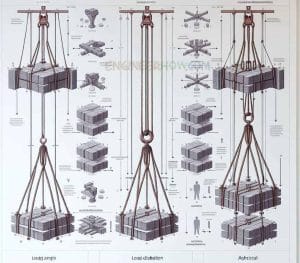
5. Lifting Equipment & Accessories
Common Lifting Gear:
Slings – Webbing, wire rope, chain.
Hooks & Shackles – Bow shackles, D shackles.
Spreader Beams – Distributing load evenly.
How to Select the Right Lifting Accessories
Check SWL (Safe Working Load) ratings.
Inspect for wear & tear before use.
Ensure compatibility with lifting plan.
Workplace Example:
A warehouse used incorrect shackles for lifting a 15-ton container. The Appointed Person identified the issue, replaced them with high-capacity shackles, and prevented equipment failure.
Diagram: Types of Slings & Their Uses
(Illustration of different sling types and configurations)

6. Crane Selection & Drawing Sequence
Steps for Selecting the Right Crane:
Identify load weight & dimensions.
Check crane lifting capacity from load charts.
Consider outriggers & ground conditions.
Position crane for safe operation.
How to Read a Crane Load Chart
(Table explaining boom length, radius, and load capacity)
Workplace Example:
A contractor chose a crane with an insufficient boom length for a rooftop lift. After reviewing load charts, a longer boom was selected, ensuring a successful operation.
Sample Crane Selection Diagram
(Diagram showing crane setup with load positioning)
Conclusion: Best Practices in Lifting Operations
✅ Always follow safety regulations (LOLER, BS 7121).
✅ Conduct thorough risk assessments before lifting.
✅ Use certified lifting accessories & inspect regularly.
✅ Train personnel & update lifting plans regularly.
💡 Do you have experience in lifting operations? Share your insights in the comments below! 🚀


