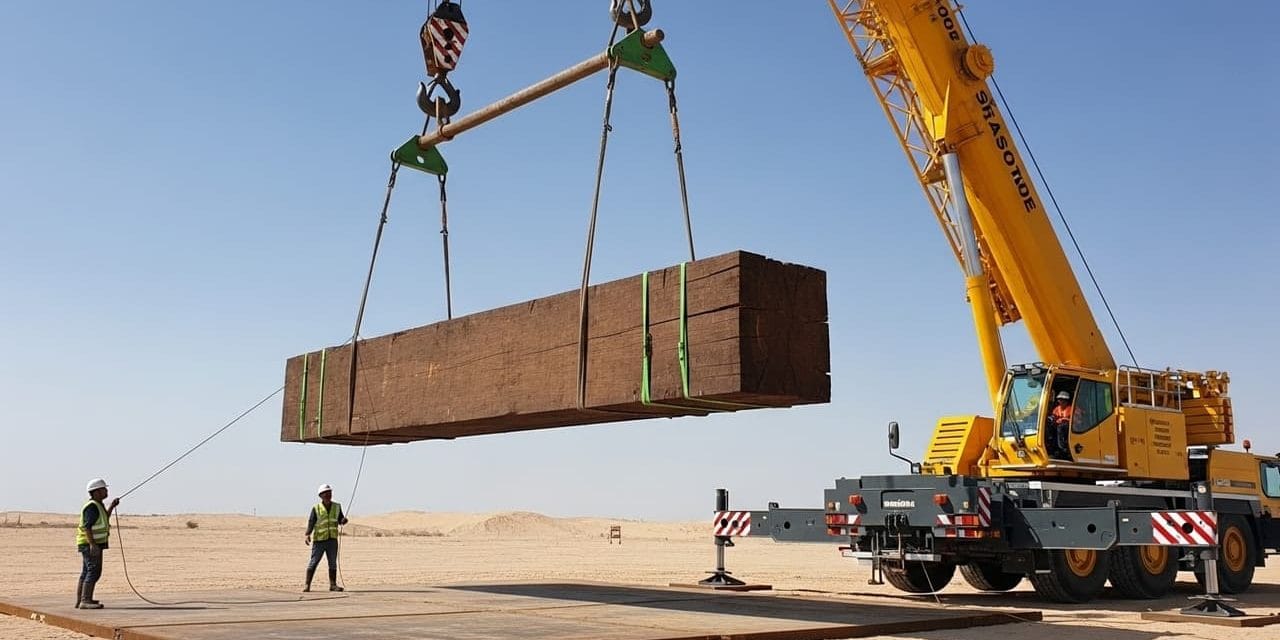
Overview
One of the most common mistakes in lifting operations is underestimating the weight of natural materials. Unlike steel or concrete, wood has a variable density that changes with moisture content.
In this guide, we break down a real-world scenario: Lifting a massive
We will walk you through the entire planning process—from calculating volume and density to selecting the right wire rope slings and determining if a 100-tonne mobile crane is actually enough for the job. This guide aligns with BS 7121, RTITB, and PDO (Oman) standards.
1. The Scenario: The Mystery Load
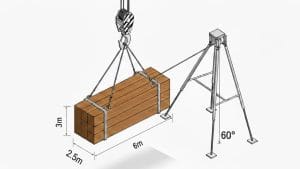
We are tasked with lifting a large wooden block with the following dimensions:
- Length (L):
6.0 meters - Width (W):
2.5 meters - Height (H):
3.0 meters - Material: Seasoned Hardwood (Oak/Teak type)
At first glance, it’s just a block of wood. But without a confirmed weight ticket, how do we choose the crane? We have to calculate it.
Step 1: Volume & Density (The Physics)
First, we find the volume:
Next, we determine density.
- Softwood (Pine):
500 kg/m^3 - Hardwood (Standard):
800 kg/m^3 - Wet/Green Wood:
1,000 kg/m^3
Safety Rule: Always plan for the worst-case reasonable density. We use
Net Weight Calculation:
Step 2: Adding the Safety Margin (+25%)
Because this is an estimated weight, standards like BS 7121-1 and PDO SP-2275 (Refer sp-2275 page 24,26) require a safety contingency. We add 25% to account for moisture, mud, or internal density variations.
- Contingency:
36,000 x 0.25 = 9,000 kg - Load for Slings:
36,000 + 9,000 = 45,000 kg
Key Takeaway: The “36 Ton” load is actually a 45 Ton lift before we even attach the hook!
Step 3: Sling Tension & Selection (using Scientific/Mobile Calculator)
Using a 4-leg wire rope sling at a
Input:
- Load: 45 Ton
- Legs (N):
- Angle: (60 Degree) sin 60 = 0.866

Accessories / Hardware Selection: Based on 17.4T Tension per leg

Step 4: The “Hidden” Rigging Weight
Many crane accidents occur because the rigging weight was ignored. For a lift of this size, the tackle is heavy:
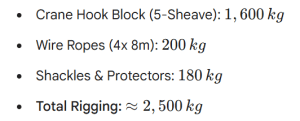
Component Specification Unit Weight Qty Total Weight Crane Hook Block 5-Sheave Block (Standard for 100T Crane) 1600kg 1 1600kg Wire Rope Slings , Length (Steel Core) 50kg 4 200kg Shackles 25 Tonne Bow Shackle 15kg 4 60kg Master Link Heavy Duty Master Link assembly 60kg 1 60kg Corner Protectors Heavy Steel Sleeves (Fabricated) 15kg 4 60kg Rigging Screw Turnbuckles (for leveling CoG) 25kg 2 50kg Taglines Polypropylene 2kg 2 4kg TOTAL RIGGING 2034kg
We will round the Rigging Weight up to 2,500 kg to be conservative.
Final Gross Load for the Crane:

Step 5: Crane Selection & Utilization
Can a 100-Tonne Mobile Crane do the job? (e.g., Liebherr LTM 1100) It depends entirely on the Radius and the Utilization Factor.
- Counterweight: Full ballast (35T).
- Boom Length: – 11.m – 15m (Base Section).
Understanding Utilization:
Utilization is the percentage of the crane’s capacity being used.

- < 80%: Standard Lift (Green).
- 80% – 90%: Heavy Lift (Amber) – Requires specific Risk Assessment.
- > 90%: Critical Lift (Red) – Usually requires Engineer approval and wind restriction reduction.
Radius Analysis:
| Radius (m) | Typical 100T Capacity (T) | Gross Load (T) | Utilization | Status |
| 4.0 m | 68T | 47.5T | 70% | OK |
| 5.0 m | 59T | 47.5T | 80.5% | HEAVY LIFT |
| 6.0 m | 50T | 47.5T | 95% | CRITICAL (Avoid) |
| 7.0 m | 42T | 47.5T | 113% | FAIL |
Verdict: A 100T crane can only perform this lift if it can park within 5 meters of the load. If the reach is greater, you need a 160T crane.
Step 6: Alternative Sling Scenarios
What if Wire Rope is unavailable? Can we use Chain or Webbing?

Option A: Chain Slings (Not Recommended) To handle 17.4T per leg, you would need 22mm Grade 80 Chain.
- Issue: A 4-leg set weighs over 250kg.
- Risk: Extreme manual handling risk for riggers trying to attach it at 3m height.
Option B: Webbing/Round Slings (High Risk) You could use 20 Tonne Round Slings (Orange).
- Issue: Wood edges act like knives under 47.5T of pressure.
- Control: You MUST use cut-proof sleeves (Polyurethane/Kevlar). Fire hose or rags are not sufficient.
- Verdict: Wire rope is the safer, more durable option for timber.
8. Critical HSE Controls
- Ground Bearing Pressure & Outrigger Pads:
- The Physics: A 100T Crane (60T Deadweight) + Load (47.5T) = Total 107.5T.
- Point Load: When slewing over a corner, up to 75% of this weight can transfer to one outrigger (=80T point load).
- Requirement: Standard crane pads are insufficient. You require Large Steel Mats or heavy timber cribbing (min 2.5mx2.5m) to spread the load.
- Calculation: Ensure Ground Bearing Capacity (SBA >15t/m square) .
- Density Verification:
- Since we used 800kg/m square , if the wood is actually wet (1000+), the load jumps significantly.
- Control: The crane operator MUST perform a “pick and hold” (test lift) just off the ground. Check the LMI. If it reads >48T, STOP.
- Taglines:
With a 6M x3M face, wind pressure is high. Do not lift if wind speeds exceed 10 m/s (or refer your company/client standards).
Conclusion
Lifting operations are 80% planning and 20% execution. By breaking down the density, adding safety margins, and accounting for the “hidden” weight of rigging, we ensured a safe lift.
Need a detailed Lifting Plan template? Check out our resources section or contact us for bespoke training materials.
We recommend bookmarking this guide from EngineerHow.com for future reference. Our goal is to make complex technical topics simple and accessible for everyone.
🔗 Useful Links
- 📺 EngineerHow YouTube Channel: www.youtube.com/@EngineerHow
- 📢 About EngineerHow.com: EngineerHow.com is dedicated to providing expert IT and engineering tutorials, helping professionals and enthusiasts set up servers, networks, and self-hosted solutions. Our guides focus on step-by-step instructions to make complex topics easy to understand.
🚀 Explore More IT Guides: EngineerHow.com
💬 Join the Discussion! Have questions or insights? Drop a comment below and let’s discuss!
Copyright © 2026 EngineerHow.com. All Rights Reserved.